
I thought I already got it. I’d talked feminism with a feminist before, we agreed on a lot, and I counted myself as one of the men who supports it.
I love my mom. I love my sister. If you had asked me a month ago whether I was one of the good ones, I would have said yes without blinking.
I even had a picture of the partner I wanted someday. I’d watch Leila and Alex Hormozi online and think: that’s it. A woman who co-founded the company, is its executive chairwoman, works hard, makes her man better, and still shows care by cooking for him, at least in one video I saw. (I only know them from clips, so I’m not claiming to know their marriage.) In my head that was equality with love on top: a woman at the top of her game who chooses to take care of her man.
I thought that was the dream. Then I got on another call, and this one felt like a rebirth.
The call
A real friend of mine, a feminist, on a long call. I’d had a version of this talk before and agreed with almost all of it, so I thought I knew where this was going. I didn’t.
We started with how feminism began, and I learned that some of the women who started it were bombing buildings. Then we got into the gap between white and Black feminists: who the movement stood for, and who it left standing outside when it counted. Then we moved to marriage. Then prenups.
I was speechless so many times. The first time was when she pointed out how men underplay women’s achievements. She told me about a lecturer who brushed off her CGPA and said, dismissively, that she’d end up in a man’s house anyway.
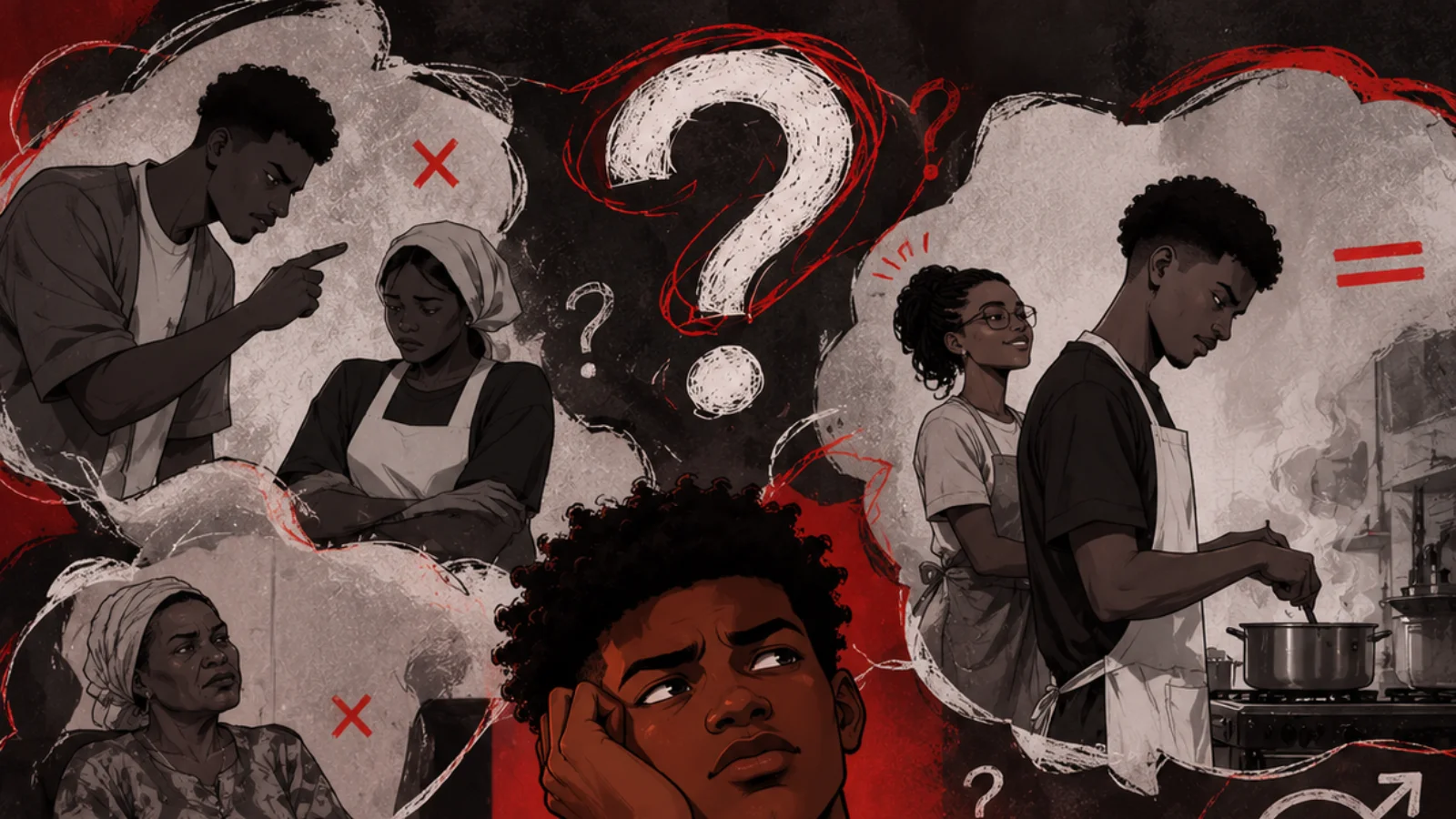
The second time was harder, because it was about me. She said a woman shouldn’t be the one who has to care, cook and carry a role that was put on her for no reason. I pushed back. I was still defending the traditional picture, because I believed men have a fixed role too, and in my head it could only go one of two ways: the woman takes the man’s role, or the man takes hers. She made me see that swapping roles isn’t enough. You have to question the whole paradigm. That’s when I went quiet.
The facts were glaring, and they weren’t about “society” anymore. They were about me. I’d agreed with feminism before, but that agreement lived in my head. It had never touched my own picture of a partner.
The book
My friend deserves the credit here. She’s the reason I read this book.
I picked up We Should All Be Feminists by Chimamanda Ngozi Adichie, and boy oh boy, it made everything clearer, and more glaring. I realized I wasn’t just watching the problem. I was part of it.
She asks why women do more of the housework: is it a cooking gene, or is it socialization? Then she points out that most of the famous chefs in the world, the ones with the fancy title, are men.
And then there’s the family she describes. A son and a daughter, a year apart, both brilliant at school. When the boy is hungry, the parents tell the girl to go and cook Indomie for her brother. The girl doesn’t even like cooking Indomie. But she’s a girl, so she has to.
I read that and I stopped, because I wasn’t reading about some family. I was reading about mine.
My sister
When we were younger, my sister and I both wanted to do our own thing. I can’t even remember the exact moment, which says something: it was so ordinary it never registered. But she was the one asked to cook for us both. Not me. Her.
I never questioned it. Nobody did. It was just how the house worked.
Now she cooks, and I told myself she looked happy doing it.
So I finally asked her. She told me she doesn’t really enjoy it: “It’s very stressful.” What she likes is when people enjoy the food.
I asked whether it’s different from when she was first made to cook. “No, it’s not. I’m still asked to.” If nobody expected it, she wouldn’t do it so much. She assumes she’ll be the one, “so I just do it before anybody has something to say.”
She wasn’t happy. She was ahead of the criticism.
My reaction was: wow. Assumptions aren’t enough. I’d assumed all my life that she enjoyed it, and she doesn’t. It’s the only reality I’d ever known, and then I found out there was a whole different one underneath it. Now I have the doubt, and the feeling that I have to be reborn and start again from scratch.
Assigned or chosen
Cooking for someone isn’t the problem. Being told to cook because of what you are is.
“You’re the girl, so you cook” is an assignment. “I like cooking for you” or “I’ll cook tonight, you cook tomorrow” is a gift. The act is the same. The freedom behind it isn’t.
My sister gave me the test without meaning to: if nobody expected it, she wouldn’t cook so much. That’s assigned, whatever it looks like from the outside.
The honest dispute isn’t whether women can enjoy these things. It’s how free the choice really was.
What I haven’t figured out
I know a guy a friend used to date. He was sweet. He did her hair and made food for her. She was well cared for. And still, the idea didn’t sit right with me.
That’s part of the raw truth. Roles seem so important to me, and I think that’s exactly what I’m trying to challenge.
So where do love languages fit in? I don’t want to dismiss showing care in those ways. Cooking, doing someone’s hair: those are real ways to love someone. But when I picture them expected of me, they feel feminine, and that feels threatening. That’s the irony, and it was lost on me: I’d expected those things from women my whole life without a second thought.
And here’s the rest of the raw truth: I’m scared. Not of women. Of the unknown. The way I was raised came with a script, and a script is comforting. I knew what a man does and what a woman does. I knew where I stood. Losing that certainty for a new paradigm, one I don’t have a map for, feels like standing on a floor that might not be there.
If you’re a man reading this and you feel something similar, I won’t tell you it’s irrational. I’ll tell you it’s the price of admission. Nobody is asking us to feel nothing. We’re being asked to stay in the room.
What I’m doing about it
I’m not writing this as a man who figured it out. I’m at the beginning.
I’ll keep reading, that’s for sure. Sitting in discomfort is something I already do a lot, so I want to stay in the discomfort of those two conversations, the one with my sister and the one with my friend, and figure out where I fit in all of this and what I’ll do about it.
Your turn
One simple question: in the house you grew up in, who cooked? Who was given a specific role? And who was the one who got asked to do it?
Then, did anyone ever ask them if they wanted to?